Update 23 June 2013

Today will be a simple post of this week’s activities.  There are a couple stories I would like to tell, but I have not taken the time to think them through and write them out.

On Tuesday we will have been here two months already!  This past week we focused on the following:

1)      Language and culture training – learning the basic introductions of the Lugandan language, practicing the language and experiencing places in Jinja and our community.

2)      House work – planning mosquito screens, sealing cracks and cleaning around the 18 windows of the house to cut the amount of critters coming in.  This is a job!

3)      Assisting Michelle and the kids in 3 days of ministry at a women’s conference.  Our three children assisted a church from Arkansas in providing childcare for missionary mothers during the conference.  This fit really well with our three kids.  Michelle watched kids the first day, too, but joined the conference the second and third day.

4)      Equip Uganda policies and procedures – I (Mark) am writing proposed policies for our NGO (non-government organization, i.e. Equip).

5)      Immigration items – pulling together items I need for my work permit request.

This afternoon we hosted 8 singles (four of those are interns from the States), three families (with a total of 12 kids) and our bunch of 9 for a house Bible study, which I led.  Michelle and I both enjoyed having these folks in our home and fellowshipping with them.  We rotate homes for the weekly Bible study.  And yes, I did write our “9.”  Our family has doubled from five members to nine – twelve on weekends, depending on how you count them.  I will write more about this in the future and introduce these folks to you then.

This week looks very similar to last week, with immigration and mosquito screens moving to a higher priority of things to do.

Mark with a bunch of Matooke (cooking bananas)

Mark with a bunch of Matooke (cooking bananas)

The picture is a photo of Matooke (pronounced mah toe kee, which are cooking bananas).  The consistency when cooked is like thick mashed potatoes, but turn out yellow when cooked.  Matooke is served with peanut (ground nut) sauce.  We also had rice, and green beans, but at the last minute Ruth changed the green beans out for a cabbage and pea mixture that tastes like something cooked at a Japanese restaurant.  Very delicious.  This entire bunch was purchased for about 12,000 Ugandan Shillings or $4.60 US dollars.  We ate less than one fourth of them Saturday night.

Josh did not like bananas before moving here, but now he eats bananas, and he “loves” matooke.

Aside

A friend of mine shared a song, “Clear the Stage” with me today. It seems to go along with the post, “Do You Ever Want More?” so I added the song link at the end of the post.
Great song, and lyrics are awesome. Post is below.

Do You Ever Want More?

Wheat "White" for Harvest

Wheat “White” for Harvest
Photo by Ferrell Jenkins used according to Permission Rights.

Really, do you in all honesty, fact and sincerity want more?

You might ask, more of what?  More time?  More motivation?  More satisfaction?  More strength?  More happiness?  More money?  More from your spouse, friends or kids?

On Monday, Luke Anderson (an Equip teammate) and I went to Kampala.  He was showing me where the immigration offices were and he was picking up a document from there.  As he was waiting in line, I was reading the first chapter of Counterfeit Gods by Tim Keller.  The words provoked me, and caused me to think about having more – more insight and ability to see spiritually like Jesus did.  Had that desire become an idol, secondary to intimacy with Jesus?  It seems so.

The white bus with a blue stripe is similar to the bus Luke and I travelled in from Jinja to Kampala.

As we had wrapped up our business at immigration and were traveling home in the bus, I was sitting next to a window near the back of the bus.  I was still pondering what I had read.  Why could I not see the mission field as “white with harvest” as Jesus could?  I mean, really.  Jesus seemed to see fields ready for harvest – he saw “white.”  I am more likely to see fields bare, hot with sun, lacking rain and possibly ready for planting or waiting for growth.  I see needs, but I do not see desire.  Apparently I don’t have the eyes to see desire or hunger for God.

Later, as I pondered these things near the back of the bus that was returning to Jinja, a girl probably in her 20’s was sleeping in the seat directly in front of me.  She jolted me from deep thought with rapid outbursts of loud and dramatic screams.  At first I thought the bus was about to wreck.  All attention in the bus quickly turned to her.  The man next to this girl leaned away from her and moved away a few inches in fear, while the man in front of her got up out of his seat and turned around.  Not sure what to do I leaned forward, began praying and touched the girl on the back, lightly consoling her.  By this time the man in front of this girl had asked to switch places with the man beside the girl.  The man beside the girl did not hesitate for a second, looking for any opportunity to separate himself from the unknown.  He quickly exchanged places, moving forward to the other seat.

The man moving from in front of the girl showed signs of age and maturity, with a small splotch of gray in his hair near his sideburns.  He was probably in his 50’s.  As he climbed over his seat and moved one row back, he looked at me and verbally expressed appreciation.  I could see in his expression that this was not the first time something like this had happened.  He knew what to do and quickly took his new seat to the girl’s right and wrapped his left arm around and behind the girl.  Since I was behind her, I placed my right hand on her head and gently stroked her tightly cropped hair.  She very slowly laid her head back awkwardly against the top of her seat while turning her head over her left shoulder.  As her face came into view I could see thick, white and clear sputum dripping from her mouth.  While she had stopped screaming, her eyes were crossed as she slowly looked back at me.

Our eyes connected only briefly.  The man who was holding her to her right quickly reached with his right hand across her face and brushed her eyelids closed.  The look in this girl’s eyes reminds me now as I write, of the barrenness of her field.  Her outburst stirred compassion and questions within me.  How long had this girl and this man endured the pain and embarrassment of this affliction?  Was the outburst a result of a seizure?  Was it the result of a witchdoctor?  Was it due to cerebral malaria?  Was it a result of abuse?  Had this man taken this girl to a witchdoctor for help?  Had he sought help from numerous church leaders to pray for healing or cast out demons?  How often did this happen?

These questions still remain.  I wasn’t sure how to respond and the bus was noisy.  I didn’t want to bring more attention to the girl and she seemed to need to sleep, which eventually came to her.  So I did not follow up in conversation with the man.  And he did not turn and seek conversation with me, or anyone else for that matter.  People were eerily quiet while the noises of the bus, its radio and the noisy sounds of travel in Uganda were heard.  People seemed to fear another jolt of the unexpected.

As we continued our journey down the dusty road between Kampala and Jinja, people occasionally glanced back at the girl to see how she was behaving, if she was OK and look for signs of another outburst.  It did not happen.

I was left questioning.  Was that a “white” field ready for harvest?  If it was, what should I have done?  And why did this man not ask or seek?  Was he weary from seeking help?  Perhaps he had come to the place of acceptance with this burden.

Have we come to the place of acceptance with our burdens?  With our struggles?  With our sin?  With our, “I’ve blown it again” thoughts?  With the mundane?  With the barren fields?  With things as they are?  What is God up to?

Full moon occurs at every Passover (usually in March or April).

A full moon occurs at every Passover
(usually in March or April).

At a very quiet and intimate time in the life of Jesus and his followers, the betrayer restless with Jesus not doing more about bringing his kingdom to the earth and overthrowing the wicked Romans, left the sweet fellowship of Jesus to do his dastardly deed.  As Jesus’ life was drawing to a close the full moon cast light into the darkness.  Similarly the Rabbi teacher shed a glimmer of revelation into the dark mysteries of intimacy and closeness with Him, “If you abide in Me, and My words abide in you, you will ask what you desire, and it shall be done for you.”

Oh, do you not long for that day – to ask of the Master, and then to receive?  I wonder how much anticipation the older man and girl in the bus have for this day, “to ask for release of their burden” and to receive.

Abide.  The word means to remain; wait for; tarry; be prepared for; watch; bear patiently; tolerate; remain stable or fixed in some state or condition.

As I write, Michelle just finished up today’s women’s Bible study.  She has no idea of the subject I am writing, and she was telling me her study today was on God’s timing.  The lesson she received was, “We wait on the Lord – that is where our strength is.”  She continued, “Waiting on an event or a person depletes us.”

What does that mean?  Deplete means to “empty or unload; use up resources; consume vital powers of; exhaust.” Webster’s 1913 dictionary gives a graphic illustration of the word, to empty by (the old fashioned medical procedure of) bloodletting.  Loss of blood literally and figuratively drains a person of their strength. Fresh blood, on the other hand, brings strength to a person.  I witnessed that truth first hand at Hospice when patients would receive a blood transfusion – their strength and vitality; their life would return.

When we cast our sins on Jesus through confession and repentance, the blood of Jesus cleanses and brings life, strength and vitality to us.  We abide, waiting not for some event to happen, but abide in getting to know Jesus.  How long did Jesus wait before His Father said, “Go!”?  How long do we wait for His return?  Waiting brings strength – strength from our quiet time; strength from learning patience; strength from knowing the passion, waiting and suffering of our Savior, the Christ.  The relationship with Him is the most important, for that relationship will last for an eternity.  So do you want more things to go your way?  More events to happen soon?  More people to live and do things the way you want them?  Or do you want more of Jesus?

If you want more of Him, simply ask.  As you wait on Him, He promises that He will give you what you desire. 

Update 2013 June 9

Update about what’s happening with us, but first just a note to say it’s amazing to see how my experience has led up to this job here in Uganda.  I will be working on developing policies and procedures and a handbook for volunteers and new missionaries who arrive on the field with Equip.  I was told by Jeremy and Chris at our first Equip Uganda leadership meeting that my job had changed from 80% ministry / 20 % admin to 80% admin / 20% ministry.

Although a bit disappointing, this is entirely necessary for the stage of growth that Equip Uganda is in.  I look forward to assisting our team in getting Equip Uganda started.  We’re working on mission statement, vision statement, purpose statement and other admin things that will better develop the direction for the organization in years to come.

One of the biggest challenges we face is coordination with other NGO’s (non-government organizations).  We hope to set up some coordinated efforts to make ministry in Jinja, and specifically Masese slum more efficient, with better communication.

Now on to our week this past week:
Tuesday, June 4th we move into the Sperlings home, about 5 miles or so east of Jinja.  We spent most of the day settling, organizing and cleaning our stuff.

Wednesday, June 5th – 1st day of formal Luganda Language training.  Wow!  We purchased a Learning Luganda CD in late 2012 from Amazon and have been going through

it.  The kids are doing great and the parents…not so bad.  The CD has some mistakes, we’re finding out.  The CD says “please” in Luganda is embwa.  However, embwa means “dog.”  So you can imagine why our restaurant server looked at us funny when we thought we said, “Please” and we really said, “dog.”  Not good.

Also on Wednesday we had a couple items to take care of with the house – the most

 
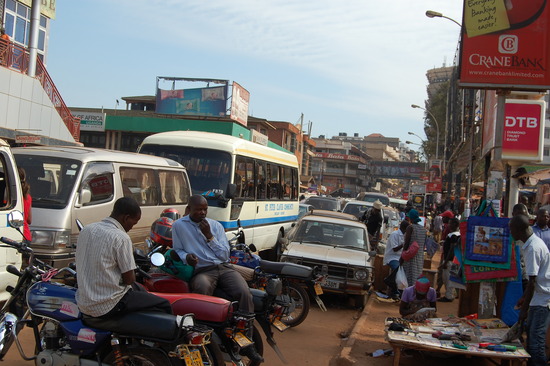
A snapshot of Main Street, downtown Jinja.

important was to get a quote to install mosquito screens for the windows in the house, in A snapshot of Main Street, downtown Jinja.order to cut down on malaria.  Finally I begin driving in Uganda!  This is insanity – driving on the opposite side of the road and the drivers seat, gear shift, rear view mirror, radio, signal lights, etc. etc. all opposite.  The only thing that remains the same, thankfully is that the gas is on the right foot and clutch on the left foot.  Oh, and backing the vehicle is opposite, too.  Pedestrians have no rights and yet they will walk in the road.  Vehicles stop in the road.  Botas (small motorcycles) drive the wrong way on the road.  Traffic drives in the evening with no lights on or their high beams on.  Stop signs are disregarded by everybody.  No such thing as lanes – if you can squeeze by, then do it no matter where you are on the road!  Speed in reality is somewhat regulated by using potholes to slow traffic.  They will use speed bumps, too.  You really take your life in your hands.  I haven’t prayed like this before when driving – seriously.

Thursday was men’s group and meeting with teammate Jeremy for our monthly Equip team meeting on Friday morning.  More driving!  We also shopped in town for basic necessities around the house – remember we’re somewhat starting over again.

Friday – Equip Uganda monthly meeting discussing past months activities, future plans, better coordination of activities, communication, financial reporting, mission, vision, purpose, etc.  2nd quote on the mosquito screens since the first quote was so high.  Passport photos for new drivers permit.  Repaired some minor things Friday evening around the house.  Paid the water bill.  Got groceries.  All this stuff takes extra time due to things like language, not knowing the area, new money, new culture, etc. etc.  A number of times I feel like I’m being cheated.  I was charged $25,000 shillings (about $10) to repair a zipper on my suitcase from the trip here, when I found out I really should have paid only about $5,000 shillings.  The guy charged me higher because they assume because I’m white I have money – in the US some people consider that racism.  Here, discrimination is part of life.

Saturday – personal time. Michelle meets with a fellow missionary wife.  Mark takes care of some personal business.

Sunday – FB a request from a supporting church to provide information about missionaries (that church has VBS this week).  Attend our church in the morning.  Lunch at our house with one of our Equip teammates.  Bible study at another missionary home at 3 pm – meet new interns from the States;  Michelle and girls attend a missionary appreciation dinner at 6 pm for females (moms and wives), while I write our blogs.  It’s 12 midnight.  I’ve got to get to bed!

Monday morning 8:30 am – ride with Luke and others to Kampala (3 hours away) to get my drivers permit and learn about immigration while there, since I will have to apply for a work permit in July.

This past week has more to do with settling into the house and culture than most anything else.  Thanks for prayers!  They mean more than you know!

Learning the Importance of Engaging Others

On Monday, June 3rd at about 6:00 pm local time, I was approached on Main street in Jinja by Abraham, a twelve-year old local boy who saw our family of mzungus (white people) leaving a restaurant.  I was in a rush to get back to the Guest House to be with my family, yet this young guy caught my attention briefly by mumbling, “I wahnt sahma fuhd.”  Due to his thick Ugandan accent I had to ask him what he said.  He repeated the request which I understood this time, but he would not look me in the eye, “I want some food.”

Abraham did not look like a street kid – he was healthy-looking, dressed well, and knew where the street kid ministries were located that could help him.  He was unfortunately learning how to get what he wanted from the mzungus.

This is not the only time I have been asked for food or money since arriving here in Jinja.  I’m not complaining, it’s just caused some thought.  I was asked by two different parents to help them sponsor their children in school since school fees here are expensive and many families have numerous children.

Being in Jinja for just over a month now, I already see the power of money in a third world country.  The easiest, quickest response is money, and we’ve done that too.  Everyone wants just “a little bit more.”  And don’t we as Americans have relatively a lot of it?

So how are we to handle requests for money and food, especially when so many programs exist to help?

It’s interesting that there is an example in Scripture about money that leads us to what I think part of the answer is to this dilemma.  At first glance, the story may not seem to connect with this blog, but think about it more deeply.

MoneyIn Matthew 22, the story is recorded.  The Pharisees ask Jesus:  17Tell us, therefore, what do You think? Is it lawful to pay taxes to Caesar, or not?”

  18But Jesus perceived their wickedness, and said, “Why do you test Me, you hypocrites?   19Show Me the tax money.”

So they brought Him a denarius.

  20And He said to them, “Whose image and inscription is this?”

  21They said to Him, “Caesar’s.”

And He said to them, “Render therefore to Caesar the things that are Caesar’s, and to God the things that are God’s.”

Brilliant answer.

The well-known Christian apologist, Ravi Zacharias in discussing this section of Scripture thinks that the Pharisees missed a great follow up question, which in his opinion they should have asked Jesus.  That question being, “And what belongs to God?”

Ravi thinks Jesus’ answer to this hypothetical question would have been something like, “Whose image is on you?”

On us?  Is there an image and an inscription on us?  According to Genesis 1:27 man is made in the image of God.  God’s image is on us!  So we belong to God – his workmanship and creation.  What about an inscription?  Incredibly Isaiah 49:15-16 tells us this truth, “Can a woman forget her nursing child, And not have compassion on the son of her womb?Hand & Cross Surely they may forget, Yet I will not forget you. See, I have inscribed (Heb root is to hack; implying to enact like laws written on stone) you on the palms of My hands;”

How much we matter to God, if we just stop for a while and consider!  He desires a strong relationship!  So much that He didn’t just throw money at us, but rather He cares for us more than a nursing mother does her child.  He took the inscription of our sins onto His palms through the nails that held Him to the cross.

I am learning this point:  relationships matter and we must make the time to engage people in our busy world and not just hand out money.  Love people – that should include engaging them while feeding them or helping them and tell them the Gospel reason why we are helping them.  Should we feed or give money in all cases?  I believe we should follow the lead of God’s Holy Spirit.  An important question might be:  Does handing generous sums of money out, bring those in need to depend on further begging or depend on Jesus?

Little Abraham had engaged me – whether for legitimate reasons or not, I do not know.  As Abraham and I were talking, I thought about Abraham’s request for food.  He knew the ministries where he could get food.  I did sense the Spirit asking me to engage him and we talked about real bread – the Bread of Life being Jesus.  I trust this was the appropriate response in this situation.  It has also reminded me of the importance of my quiet time in order to be prepared to face who God is leading to me that day.

Of Truth & Death

Today’s blog will differ in writing style from previous blogs.  I divert to address a reality we all must eventually face.  As such, the topic is of tremendous importance.

Over the last couple weeks I have been faced with the reality of death:

1) With Samuel’s father (I wrote recently of his murder here in Uganda).

2) Just this past week my 86-year old grandmother, Beulah Wise, died.

3) In a Facebook chat recently with a childhood friend of mine, he shared his experience of the death of his close and intimate friend.  The death had a deep and dramatic impact on my childhood friend, even resulting in depression, numerous gravesite visits, hospitalization, a break-down, counseling and medication.

4) The subject of death indirectly arose in the last couple weeks with a 30-something year-old young man (who admitted he has left Christianity for further enlightenment and spirituality).  He stayed with us for about two weeks at the house where we resided here in Jinja during the month of May.  I deeply desired to hear more of his thoughts and how he constructed his beliefs.

5) The reality of death came up in my quiet time yesterday and then again, today during our pastor’s sermon at church this morning.

Additionally, most of my friends and family know that I worked in Hospice care for 15 years, surrounded by stories and the reality of death.  That reality of death and watching how different people responded to it has intrigued me and caused me to reflect on what happens after death.

From my childhood, up until I was in my 30’s I was taught from the Bible that death is a “sleep.”  This meant, as I was told on numerous occasions with Biblical references and as I understood it, the person was not consciously aware of their surroundings when they are dead.  Then, later when Jesus returned, there would be a resurrection of the saints.  That belief was similar to what Jehovah Witnesses believe about death.  I recognize Biblical elements in that belief, but also am aware of some of the inadequacies of those beliefs.

One fact I remember about my grandmother was her continual longing to depart to “be with Christ” – something the apostle Paul referenced in the book of Philippians, chapter 1.  She vocalized to me a number of times the fact that she could not understand why my grandfather died first and why the Lord kept her here as long as He had.  She also communicated on numerous occasions that she was “ready to go.”  She had a confidence about her death and did not fear it – similar to the apostles.

This I admired, since by contrast, as I matured, I feared death.  I was not confident in the final decision Jesus would make about my life.  I was not assured of salvation.

It is not the purpose of this blog to analyze or attempt to argue about my beliefs.  My desire in this blog is to think reasonably and Biblically in forming an understanding of death (not just what people think about it) and present what I understand here in this blog.  I am more confident about some of my views about death now because my beliefs are rooted in certain Biblical truths, but I certainly do not claim to have “total truth” about death.

For any topic, especially one as serious as death, one must seek truth – not what one desires to believe, or wants to believe, or what other people believe, or the popular opinion of the time.  But rather what is real, not fiction or myth.

One of the positives of death is that it causes us to question life, destiny and purpose.  I would hope that questioning would cause us to discover truth in life.

Truth by definition is “that which is in accordance with reality or fact; not fiction; genuine; actual; proven; reliable; trusted.”

The first truth I am confident of is that Jesus is the life.  If there is anyone I am going to “bank on” or “invest in,” “follow,” or “bet on” (pick your metaphor) for life, it is Jesus.  Other religions and religious leaders fail miserably in making the promises that are recorded about Jesus.  He performed many miracles that resulted in improving life and at least two miracles where he resurrected dead people.  No other religious leader behaved like He did, loved like He did, nor made claims like He did, backing up those claims with “many infallible proofs.”  One of His closest followers even claimed Jesus said He was the Truth and the Life.  He not only alleviated suffering, but He set an example of how to persevere in life through suffering.  He is called a “man of sorrows” and “acquainted with grief.”  When I suffer, He understands, and to a limited extent I experience what He experienced.  He claimed to be God and He allowed people to worship Him.   He is controversial.  Many people have written of Jesus, perhaps more than any other religious leader.  At least 500 people personally witnessed Him after His resurrection.   Controversy and religious conflict and failure does not shake my confidence in Jesus.  When He says to Mary, “I am the resurrection and the life” I think these statements are such critically important statements that they deserve attention and research.  Speaking of Mary, Jesus respected and esteemed women and other cultures, which was very controversial to do in His day.  If people argue against Jesus, they usually do so by striking at the people who wrote about Him or the people who follow Him.  While there may currently be no archeological discoveries which point to a real life Jesus, I am reminded that one of the criticisms of the Biblical Pontius Pilate was the same – no archeological proof of Pilate’s existence, until a coin was discovered in 1961 with his name on it.  My desire is to follow the One who made a claim of conquering death.  That is Jesus.  Finally, one of the primary reasons I am convinced Jesus is real is because He has revealed Himself to me and my family personally.  You be the judge as to whether you think the changes have been for good.

The second truth I am confident of is that the Bible is God’s inspired word given through men.  The last (New Testament) writers of the Bible make fantastic claims about Jesus.  At least two or three of those writers were radical skeptics who remained committed to Jesus to the end of their lives.  The Bible is unique to other religious books – it has unity in diversity.  It respects people from all walks of life (thereby better reflecting the diversity in creation than any other religious book that I am aware of).  The Bible contains an amazing message.  It elevates God first, and then elevates man by stating in the beginning, man is created in the image of God.  Man fails.  God, not man, makes a way back for man.  Consider also that books of the Bible were written by people from all walks of life – shepherds, a farmer, priests, kings, a physician, fishermen, and others over a long period of time (about 1500 years), some well educated, others un-educated.  Although very hard on its skeptics, the Bible does invite and elevate those skeptics at times when they turn in favor of its God and its teachings.  It holds no single person as the ultimate, perfect person and sole source for truth other than the person of Jesus, who claimed to be God.  We see in its pages, numerous successes and failures of its followers – simply stated, we see life at its best and worst.  We see fantastic grace and mercy extended to humans in all sorts of situations and it addresses a vast array of topics.  We have warnings.  We have judgments.  We have truth.  We see fulfilled prophecies – hundreds of them.  It is written literally, historically, figuratively, poetically and dramatically.  The Bible is more resilient than any other literary work.  Over hundreds of years it has not lost its message, keeping words the same.  Men and women have died for what they believed about it.  Lives have been radically changed.  It has gone into the world like no other book in the world.  It has been translated into almost all the languages in the world.  Its message is living, breathing and sharper than any sword, convicting and changing many failures and even successes.  The Bible helps provide rational, reasonable and logical answers to critical questions of life – origin, purpose, destiny and morality.

Thus the reason for my blog.  The following is not an exhaustive explanation of death in the Bible.  It is very limited, but addresses key concepts important to my understanding of death.  Since Bible writers under the inspiration of God make claims that Jesus is the Life, has overcome death and is resurrected, I can trust the Bible to tell me what happens after death:

1)      My body perishes (1 Cor 15:53).  This is quite obvious and we do not need the Bible to tell us this fact.  However, in discussing the subject of death, we find that at least two Bible writers (Paul and Peter) claim that the body (both refer to the body metaphorically as a “tent”) is “put off” (see 1 Cor 5:1-9; 2 Peter 1:14-15) when we die.

2)      But we have a “house (contrasted with a temporary tent) not made with hands, eternal in the heavens” – something more solid, more permanent (1 Cor 5:1).  Jesus said He was going to prepare a place for us (John 14:3).

3)      The Bible reconciles both the future bodily resurrection (1 Cor 15) with the move of the believer (some call it a believer’s spirit, some call it a believer’s soul) into the presence of Jesus.  Jesus, after all, will return with ten thousands of His saints (Jude 1:14).  Soul is defined for purposes here as one’s “mind (thoughts), will and emotions.”

4)      After death, the saints will be with Jesus, Paul states in 1 Thes 5:10 that, “whether we wake (live physically) or sleep (die), we should live together with Him.”  That is, whether living physically or dead, we’re with Jesus.  Paul also equates being absent from the body to being present with the Lord in 2 Cor 5:8.  Paul also states in Phil 1:23 that he would rather “depart to be with Jesus.”  Jesus states, “that where I am, you may be also” (John 14:3).  Peter describes it this way, that shortly he will “put off his tent” implying like Paul that he too will move to a permanent, eternal house not made with hands (2 Pet 1:14).

5)      Those who are not believers and followers of Jesus will not be with Jesus.  Jesus and His followers were very clear about this.  After one of the most well known verses in the Bible (John 3:16) where John describes the love of God through Jesus and offers hope of not perishing by accepting Jesus, John then writes the following “He who believes in (Jesus) is not condemned; but he who does not believe is condemned already, because he has not believed in the name of the only begotten Son of God. 19And this is the condemnation, that the light has come into the world, and men loved darkness rather than light, because their deeds were evil. 20For everyone practicing evil hates the light and does not come to the light, lest his deeds should be exposed.” (John 3:18-20).  The Bible and Jesus have much to say about this.

Whether you agree or not, I encourage you to seek Truth.  Truth provides the solid foundation for our beliefs.  Jesus illustrated His teachings this way, 24“Therefore whoever hears these sayings of Mine, and does them, I will liken him to a wise man who built his house on the rock: 25and the rain descended, the floods came, and the winds blew and beat on that house; and it did not fall, for it was founded on the rock.
26“But everyone who hears these sayings of Mine, and does not do them, will be like a foolish man who built his house on the sand: 27and the rain descended, the floods came, and the winds blew and beat on that house; and it fell. And great was its fall.”
(Matt 7:24 – 27)

“They were stoned, they were sawn in two, were tempted, were slain with the sword (perhaps, machete?). They wandered about in sheepskins and goatskins, being destitute, afflicted, tormented – of whom the world was not worthy.” – Hebrews 11:37-38

I was able to sit down with Samuel on Monday (20th) for a couple hours and listen to his story.  This was his first day back from his home in North / Central Uganda after his father’s funeral.  Samuel’s father, a believer, was murdered in a machete attack.  For the previous story about Samuel and his father, click the word, Relationships.

As I approached Samuel that warm Monday morning, Samuel was seated and reading a book in the shade of some pine trees, in a blue plastic chair, similar to the plastic ones we’ve bought at Wal-Mart in the States.

Drawing closer, it was evident that he looked very tired.  His smile was missing and when he did cheer up briefly for the pleasantries of the initial greetings, it seemed to be with effort.  If you have gone through a tragic loss and resulting funeral, I’m sure you can relate.

Samuel stretched out his hand for a normal Ugandan greeting, which is a Western handshake, quickly changing to a “brother” handshake (where the thumbs interlock, hands elevate while the elbows drop), back to Western handshake, back to “brother” handshake, back to Western handshake.

I quickly debated in my mind whether to dispense with the handshake altogether and just hug Samuel as most Westerners would do during this serious and sobering time.  I had hugged Samuel after he had received the news of his father’s murder when he dropped by our house, prior to his leaving for his home.  That hug was natural and sincere from me, but seemed very unnatural and perhaps a bit uncomfortable to him.  Even his co-worker, knowing the gravity of the situation, only extended his forearm at that time (another cultural practice when one’s hands are dirty from working).  So I decided this time a warm handshake would be best.  It seemed to work fine, but on my end it seemed sorely lacking.

Samuel offered me his chair – the only one around – by saying, “Please,” and extending the chair to me, to which I politely refused.  The nearby threshold of the guardhouse door was elevated enough from the ground to make a relatively comfortable, although dirty seat.

Samuel gathered some photos from a very worn and torn envelope, and held them in his hand.

Just to quickly fill you in, the good news is that the outlook for Samuel’s mother is very good.  It seems she will survive.  The photos he held out for me were photos of his mother at the hospital, wearing bandages over the deep cuts from the machete attack:  one across her back right shoulder, dropping down to her side; another across her head; and a third across her lower back.  Deep wounds, the perpetrators intended to leave no survivors.

After formalities, greetings, and the photos Samuel shared his honesty in questioning, “Why?” but quickly gave testimony to his trust in God’s sovereignty from the Bible through this horrific event.  He chatted for a few minutes about his faith and God’s nature.

He eventually moved into the facts of the story as he knew them.  He said the local people know who carried out the murder (and his mother is witness, too, since she survived).  The man (we’ll call him the ringleader) who developed the ghastly plan and carried out the brutal murder, allegedly convinced the ringleader’s brother to get involved in the attack.  They also hired a third person.  This ringleader apparently had been raised on this land and wasn’t happy that Samuel’s parents purchased it and built a house on it.   Apparently land disputes, especially north of here in Jinja can be violent.  According to Samuel, it turns out the murder was over land.

The ringleader was quite serious with his scheme to kill Samuel’s parents.  In an attempt to succeed in his plan, he visited a local witchdoctor to gain power to take the two lives.

Samuel showed me photos of where the machetes hit the walls.

I asked what seemed to me to be the obvious question, “Did they catch these guys?”

Samuel recounts that while he was at home last week, the villagers found and cornered the ringleader.  The villagers called Samuel on their cell phone (amazing how technology has gotten into third world countries) and asked if they could “finish him (the ringleader).”  Samuel, being a Christian, chose instead to let justice be worked out patiently and orderly through the established governmental system.

This is a step of faith for Samuel, as you will soon see.  Samuel then calls the police to notify them that villagers have cornered the alleged ringleader and asks the police to go get this guy.  The police then ask Samuel for money to purchase 4 liters of gas for their police car, otherwise they can’t go.

I couldn’t believe what I just heard.  I clarified and restated what Samuel had just told me.  Samuel said, yes, he had to purchase the gas for the police car.

So they get in the police car and go after the ringleader.  The leader from the village, who has the ringleader cornered, calls Samuel back on the cell phone about carrying out revenge.  This leader wants Samuel to give the OK to kill the ringleader.  In fact, one clan wants to fight another clan.  Samuel and other family members insist that this not happen. He is insistent that justice should be served through the proper channels.

As Samuel and the police close in to within a couple kilometers or so, from the cornered ringleader, the man who is leading the villagers to corner the ringleader, gets mad at Samuel and convinces enough of the villagers to let the ringleader go free.  So, he escapes.  Unbelievable.

Thankfully Samuel says, they eventually find and catch up with the alleged ringleader, put him in jail, along with his brother and the witchdoctor.  The hired help, on the other hand, apparently fled and has not been captured.

It’s not uncommon in Uganda (even in Jinja) for villagers or community groups to catch a suspect and beat him or her, even more rarely kill them, as they are being dragged to the police station.  I am told by others living here, that often the police will sort things out according to who offers the police the most money.  So the community turns to their own twisted form of justice.

The burden the family of a murdered loved one has to go through in this country with police and the funeral is different and surprising.  For example, the family, if they do not have funds for the funeral, begs or borrows money (permanently) from friends.  According to Samuel, the price of the funeral including related costs like travel and food (not including hospital expenses for his mom) totaled more than $3 million Ugandan shillings (about $1,200 USD).  I have no way of verifying this amount.

I am divided as to whether I should have shared that amount.  I am not asking for money.  First, I talked to other missionaries about how I should respond.  There isn’t a clear answer.  Money has a way of sending relief, but also causing tension and relationship problems, similar to how winning a large lottery brings initial relief and pleasure, but hassles and problems quickly arise with relatives and friends who want part of the money.

Additionally, money is not the ultimate answer to problems.  I’m learning this lesson being a missionary.  I could write pages about this lesson alone.  God is the answer to our problems.  Where He provides money, it is sweet.  When He doesn’t answer with money, shouldn’t our response to God saying, “No” be contentment and ultimate satisfaction in Him?

Again, I have no way of validating the amount or ensuring that if someone did want to give that the money would get to the appropriate place.  I trust Samuel, I just do not know.  I’m trying to be as upfront and honest as I can be.

Samuel spoke of many things during the brief couple hours I was with him.  We talked of his responsibilities as a pastor, his future, his family, his faith, his world contrasted with my world, etc.

As this week progressed, Samuel seems to be doing a bit better – at least on the outside.  His smile has returned, although not as big and lasting as it was when we first arrived.  Each day I leave the house I see Samuel reading his Bible or a Christian book.  We chat and talk.

But what shines through?  Samuel’s faith in Jesus Christ!  Wow.

To be honest, I get a bit choked up seeing, hearing and witnessing Samuel’s faith, commitment and determination to his Lord and Savior when that same Savior allowed a test of faith – his father slain by the sword (or machete, as it may be).  God is receiving glory, granted it’s only been two weeks Saturday.

I asked Samuel if he has forgiven the attackers.  He said he thinks he has, but he said he could not face them.  It’s difficult, as I think anyone could imagine.

When I think of faith, too often I am reminded of the faith that results in positive outcomes:

Hebrews 11 tells us, “(Men and women) through faith subdued kingdoms, worked righteousness, obtained promises, stopped the mouth of lions, quenched the violence of fire, escaped the edge of the sword, out of weakness were made strong, became valiant in battle, turned to flight the armies of the aliens.  Women received their dead raised to life again.” (vs. 33-35a)

Those are awesome!  Much more difficult and challenging are the following verses:

“And others were tortured, not accepting deliverance, that they might obtain a better resurrection.  Still others had trials of mockings and scourgings, yes and of chains and judgment.  They were stoned, they were sawn in two, were tempted, were slain with the sword (perhaps, machete?).  They wandered about in sheepskins and goatskins, being destitute, afflicted, tormented – of whom the world was not worthy.” (vs 35b-38a)

Week 3

Perhaps this week I should title the blog, “Jinja Honeymoon, Week 3.”  Early in the week the kids were sitting with me in the living area of the house where we are staying.  I adjusted my voice to a serious tone, which they noticed immediately.  “I’ll ask a question and I want Joshua to answer first.  You need to be very honest with me.”

“Given what you’ve seen so far, do you think you can stay here in Uganda until the end of 2014?”

Joshua immediately broke my tension, “Oh, yeah.  It’s not like I thought it would be.  Staying here doesn’t seem like a problem at all.”  The girls’ answers were similar.

His answer includes the experiences of living out of suitcases for four weeks, killing numerous insects and a small rodent in the house, adjusting to dirt and lack of cleanliness, the change of food, culture, showers, power and heat.

Obviously we all miss our family and friends, for sure.  And while his answer was quite encouraging, I tend to be quite the skeptic.  So I’m willing to give it more time.  I mentioned how the next months may be challenging at times with various difficulties and that it’s usually at that time that North Carolina will tug on us.  But I praise God for His preparing us and the kids for this transition.

This past week I have been quite encouraged to see how other children in various settings have responded to our teens.  Alexis and Brittany babysat a young 3-year old adopted son (Jeremiah) of one of our team members while the child’s mother (Anna) and Michelle went out for a coffee and Anna showed Michelle the market – the market is an experience of a life time!

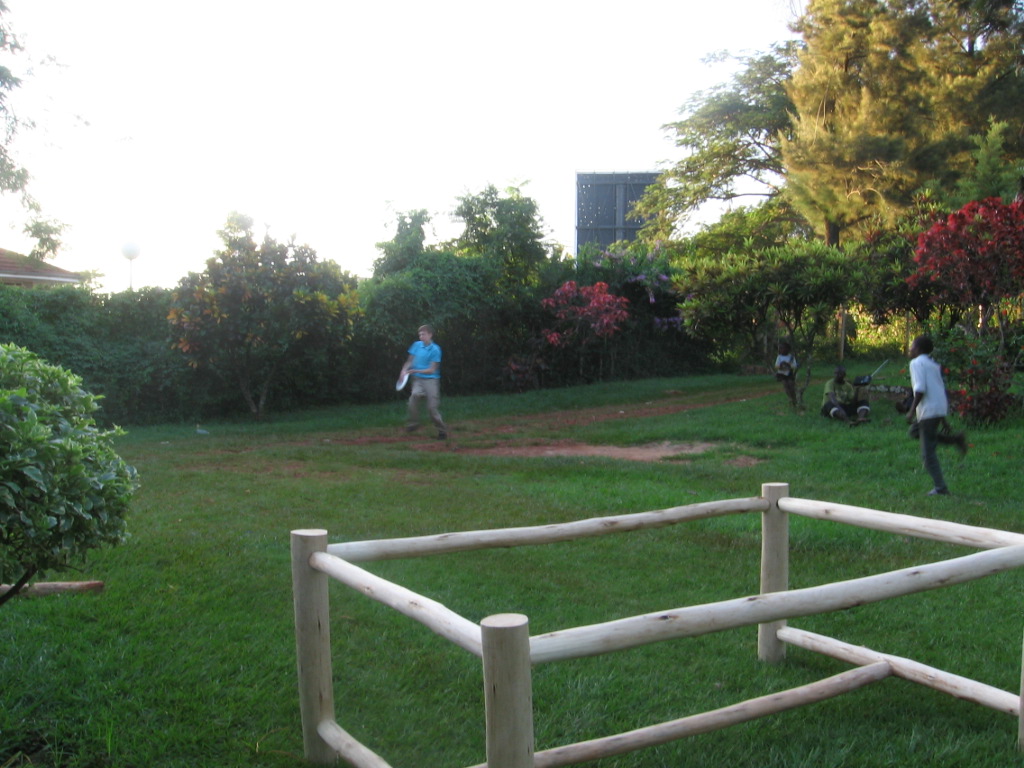
Joshua threw Frisbee and football with the caretaker’s son, Timothy, here this week.

Joshua and Timothy throw Frisbee and football with each other.  The frame in the foreground is a table being built for the house where we are staying

Joshua and Timothy (R) throw Frisbee and football with each other. The frame in the foreground is a dining table being built for the house where we are staying

Both kids really enjoyed that time together.  Timothy had such a big smile.  Later in the week when Joshua returned from town with Michelle and the girls, Timothy’s younger brother, Steven, age 3, came up to Joshua, bent both knees, lowered his head and held out his hand.  This three year-old honored Joshua out of respect.  Someone, probably Steven’s father, Moses, had taught him a powerful way to show respect.  Although the gesture was not necessary, it is evident relationships are starting to form.

At church today an eleven year-old local girl, Christine, came up to Alexis, knelt down next to her and put her head in Alexis’ lap as the congregation sat during one of the prayers.  Christine stayed with Alexis during the service, at times both arms around Alexis, playing with her necklace, hands and hair, and sitting in her lap.  At the end of the service I look over and Brittany is holding Anna, who will be three in July.  Anna is our teammates, Chris and Jane Sperling’s only daughter.

So the children seem to be fitting in and adjusting well.  Again, I praise God for His goodness in making the preparations.  Yesterday they enjoyed some video chat time on Gmail with some friends from back in Marion.

Other transitions continue to happen as well.  Michelle is starting to cook more.  We have eaten in local restaurants more than usual during the first few weeks while we adjust and settle.  At home our meals have consisted of the following:

Breakfast is easy – fresh pineapple, mango, papaya and / or banana and bread with some jam and / or eggs and water, juice or coffee.  Water has to be bottled or boiled.  Lunch consists mainly of sandwiches – usually groundnut (peanut butter) and jelly sandwiches, fruit or leftovers from the night before.  Supper has been rice with various sauces or beans, pasta, fresh vegetables or something like fried cabbage dressed up with hot dogs.  Michelle treated us to mango salsa, fresh avocado dip (from the tree in the backyard) and chips a couple nights ago – thanks to recipes from our teammate, Tamara Boone.

The variety of foods and number of prepared foods do not exist here like the States.  Items differ in price and can be expensive, while others are similar or cheaper than the US.

A snapshot of Main Street, downtown Jinja.

A snapshot of Main Street, downtown Jinja.

We have started language training, learning Luganda.  I was able to find a downloadable DVD from Amazon before leaving the States.  It seems the family is picking up the language quickly, and enjoying it.  They like the Lugandan word for toast, which consists of two words meaning “bread” and “fire.”

Josh started school back two weeks ago.  Since he was out of school for our transition here, he will be working through the summer and into the fall.

Today, the power went out from 4:30 am until after we returned from church.  Power outages really haven’t been bad since we arrived.  And today, I drove the Boones vehicle to church, without an accident – dodging potholes, botas (motorcycles), pedestrians, bicycles, all the while driving on the left side of the road, which was a challenge.  I am thankful nothing significant happened.

Tomorrow our girls will be going with Anna, our Equip Uganda team member from Oregon, to visit three or four Childrens’ ministries.  They are looking for a place to volunteer their time.  Half the population in Uganda is fifteen (15) years-old or less.

Tomorrow Samuel returns here (see Samuel’s story by clicking on the word, Relationships), and I look forward to seeing and listening to him.  I continue work (more about that in a future post), language training, learning the culture and visiting different places, like our Farming God’s Way project this Friday outside Jinja.

“Weraba.” (Pronounced “Wehr ah bah” Luganda for “Good-bye”).  All the best (and the best is Jesus!)

Relationships

Note:  Italicized words represent an update to the original story, which was first published yesterday on Sunday, May 12th.

As we settle into Ugandan life, we are being intentional in getting to know the culture and the people first.  We are going through language training and the family is doing great with it.  The Ugandan people love it when the “mzungus” (mah ‘zoon goos) or white people speak their language.  It’s a sign of respect.

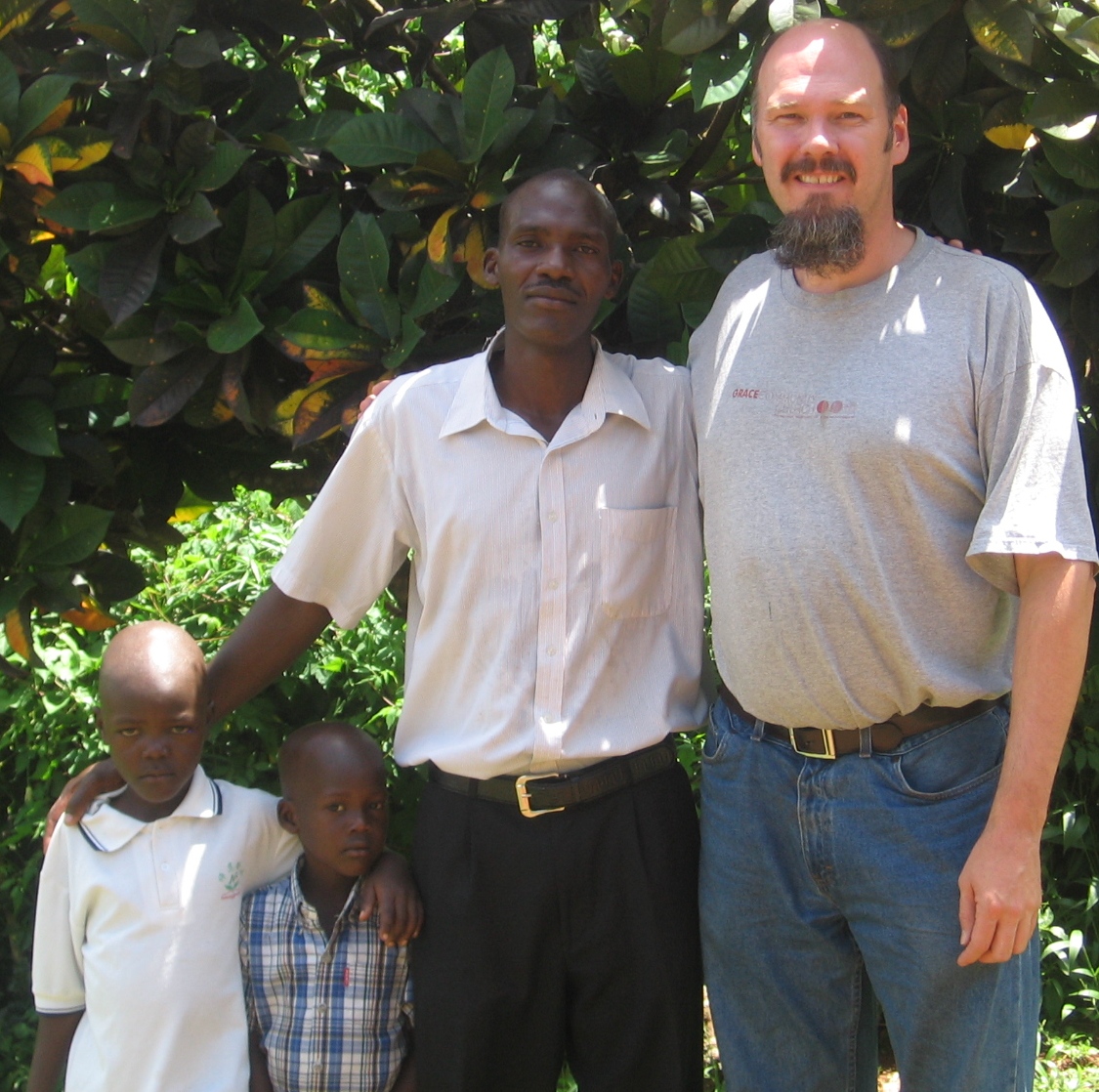
From (L): Owen (age 7); Given (age 5); Samuel (age 28); and Mark (well into his 40's)

From (L): Owen (age 7); Given (age 5); Samuel (age 28); and Mark (well into his 40’s)

Samuel is standing in the back on the left, behind Brittany.

One of the people I want to introduce to you is Samuel.  He would appreciate your prayers for a very tragic situation, which I will share with you later.  Samuel’s photograph is in our latest newsletter, which was just sent out.  At the time, I had not engaged Samuel in conversation.  He is the daytime gatekeeper for the house where we stay.  He always carries a smile, a warm Ugandan handshake and has joyfully greeted us as we come and go.  When I say he smiles, he really smiles!  Joy is one of the fruits of the Spirit God has gifted Samuel with.  It is immediately evident.

Yesterday (Saturday) morning with Mother’s Day around the corner I took an early trip into town on a boda (a small sized motorcycle) to purchase some cinnamon rolls for the family.  One restaurant in Jinja, owned by an Aussie, makes the rolls fresh each morning, although closed on Sundays.  I decided to purchase a roll for Samuel, too, and offered it to him when I returned.  The rolls are made from yeast bread and are served warm with light syrup.  They are similar to cinnabons in the States, just softer, but not as sweet.  The smile on his face was worth more than the money.  As he took the roll, he gratefully said, “Please” as many Ugandans do, instead of saying “Thank you.”

Later in the day I asked him if he enjoyed the roll.  He said he had never had one and that it was very good.

We spoke of the cost of the rolls, $3,000 shillings each (a mere $1.20 US).  Samuel said some Ugandans in a factory may work an entire ten or twelve hour day for $3,000 shillings.  I didn’t realize I was giving him such a luxury.  A day’s wage for a cinnamon roll?  Wow.

As the day drifted along, I was intentional in chatting more with Samuel and learning more about Ugandan culture.  I asked Samuel about his parents.  They live north of Jinja, about 180 – 200 km (120 miles)Both parents are Christians.  As we chatted Samuel watched the gate and I occasionally assisted Luke, a mason, in building a fire pit for our landlord.

“Do you get to see your parents often?” I asked.

“Yes, fairly often,” he replied.

We moved on to other subjects.  As the Ugandan sun heated the yard where we stood, Samuel asked me questions about the Bible.  I later found out he is a pastor and has a deep love for God’s word.  He enjoys masking the fact that he is a pastor by asking others innocent questions about the Bible.  The first couple days after we moved in, I noticed him engaging two Mormon ladies from the Mormon church next door in discussion about God and the Scriptures.

I asked him about that discussion.  He said he talked to them randomly, but intentionally for almost two weeks.  He said they told him God has a body.  Samuel, not to be beguiled by Mormon theology, asked the ladies, “God has body?  So what color is God’s skin?”  We laughed.  He said they could not give an answer.

He told me when the ladies found out he was a pastor of a born again church, they got quite upset.  He politely chuckled, as he clearly enjoyed finding more out about their errant doctrines and challenging them on those.

As we left on Saturday, we exchanged good-byes and Samuel said, “See you on Monday.”  Little did we know life would change dramatically within a matter of hours.

When we returned from church today, we got word that Samuel’s father was murdered in a machete attack at his home, apparently in his sleep Saturday night, and his mother was in critical condition.  She is in the local hospital and in a coma.  The outlook is bleak and she is not expected to make it She was struck in the head and across the chest and left for dead.  Central and northern Uganda can be very violent.  This seems senseless and Samuel says he does not know why.  His parents were building a new home in the city and this was their first or second night there.  We were surprised and somewhat in shock.  I felt numb – this man of joy losing his father and now possibly his mother that way.  The Ugandan man who broke the news to us (his name is Moses), works here for our landlord, too.  Moses who is also a believer said, “This is terrible, but it is life.”

I paused to reflect on those words – the frailty of life, life is a vapor and it’s gone.  For the believer, it’s like Paul writes, “a gain.”  Samuel is not concerned about his parents, they are believers.

I am not concerned about Samuel’s faith.  It’s strong.  He reads his Bible daily, the fruit of the Holy Spirit is evident, he loves Jesus and he memorizes large sections of Scripture.  On Monday, Samuel told me, “I know from Psalms 139 and the prophet Jeremiah that God knew about this.  God knew, but it will forever impact my life.”   With the overwhelming emotions at that point, Samuel had to sit down and cry.  As he was leaving, Samuel asked if we would pray, which we did.  I told him his brothers and sisters in the States and Canada were praying for him, too.  He is much appreciative.

He is encouraged that his American, Canadian and European brothers and sisters in Christ are praying for him and his family.  Pray for their faith.  Pray that this tragedy would result in advancement of God’s Kingdom.  Pray for perseverance, comfort and peace.  Pray as God leads you to pray for our brother in Christ.

Update:  Samuel came by to see us on Monday before leaving to go to the town where his mom lives.  He brought his two sons (in the picture above).  It was evident he was still in shock.  He said his two sons cried when he broke the news to them because they were close to their grandparents.  Samuel’s wife and daughter were in the town where his father was killed, but lived elsewhere in the town. 

Michelle and I have unfortunately had to learn too quickly about some Ugandan culture around death, funerals and grieving.  Death is a way of life here, and many times is senseless.  Samuel lives in Masese slum where our team members (and Katie Davis) serve.  As the oldest child, he will be responsible for his father’s funeral, his mother’s hospital bills, handling the affairs of the family, and apparently providing food for the visitors who come visit (a Ugandan cultural norm that seems strange to Westerners). 

Life here in Jinja, is much harder than in the States, Canada or Europe.  We knew that coming in, and we are sobered by the work of evil.  This is why Paul and John write the following:

10Love each other with genuine affection, and take delight in honoring each other. 12Rejoice in our confident hope. Be patient in trouble, and keep on praying. 13When God’s people are in need, be ready to help them.”  Jesus said, “By this (love) all will know that you are My disciples, if you have love for one another.”

Rom 12:10-13; John 13:35

The Week the Wises Moved to Jinja, Uganda

Our week moving to Jinja was a very good, but hectic one. This blog today provides an overview of our week (8 days) of moving.

Saturday, April 20th was probably one of the most difficult days. We are thrilled to have a renter in our house, and thrilled with the person God provided. But moving out of our house in one day comes with stresses and many emotions. By Saturday night we were staying at our friends (the Hoggards), who live in Marion. Rudy has been a mentor of mine for years. Love both these folks.Hoggards Home 2

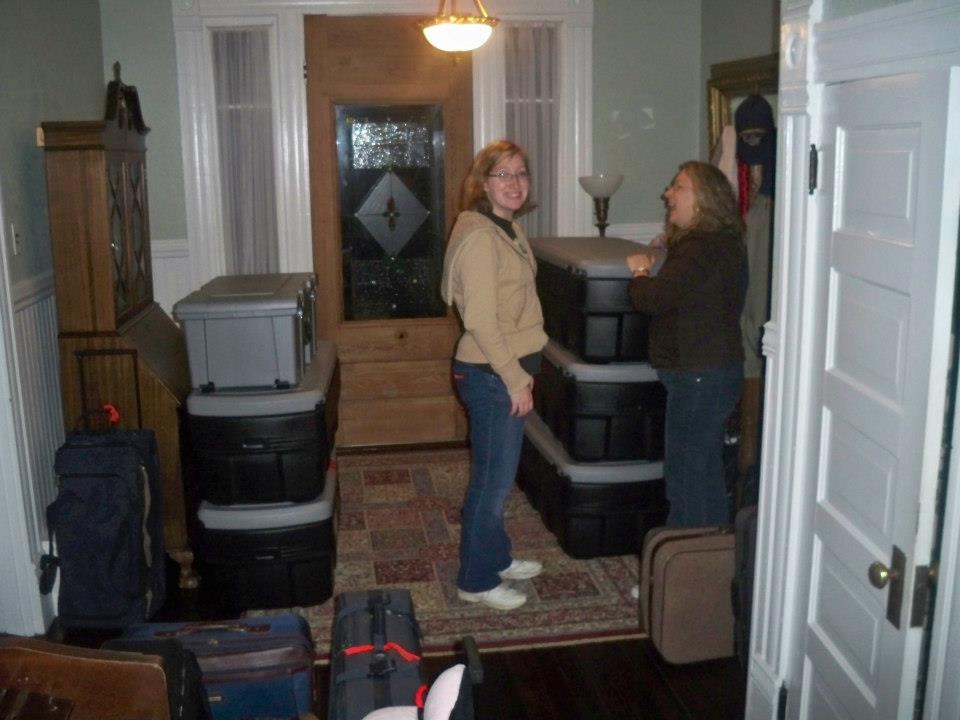
We had a lot of "stuff" to move.  Just over 1/2 of it did not make it.  Supposed to be here Tuesday.

We had a lot of “stuff” to move. Just over 1/2 of it did not make it. Supposed to be here Tuesday.

Saturday and Sunday we spent with Family and friends. Our church, Grace Community Church (www.graceforall.org), prayed for us on Sunday. Again, it was an emotional day. I learned earlier in the week about the word, “contentment” – “An internal satisfaction which does not demand changes in external circumstances.” While emotional, our hearts seemed content. Jinja is clearly where God is calling us. Sunday night we were back to the Hoggards to sleep. I still had not fully packed, believe it or not. Molly and Rudy were excellent hosts (and are excellent friends). They put us up and used their spiritual gifts of giving and hospitality to encourage us. I am sobered and happy that God has placed both of them in our lives. We said good-bye to them.

We said “good-bye” to our dog, Sox, too. Over the last two weeks she could tell something was going on. She seemed sad. Alexis snapped this picture of her.

We said "Good-bye" to our dog, Sox.  She wanted to hide her tears, but she is with Keli & Steven (our renters), who take good care of her.

We said “Good-bye” to our dog, Sox. She wanted to hide her tears, but she is with Keli & Steven (our renters), who take good care of her.

We drove around Marion with this message on the back of our van Sunday evening and Monday :-)

We drove around Marion with this message on the back of our van Sunday evening and Monday 🙂

Monday (22nd), a quick visit to the bank for some final preparations. My mom, two weeks earlier, had gotten sick with liver problems. Without going into details it was rather clear and Mom said that she thought this was clearly a spiritual attack on her. She is doing some work for us while we are gone, and we will be depending on her tremendously. She had a biopsy of her liver at noon the day we left. Wish we could have been there. The results would come in later in the week, just liver damage. Nothing conclusive causing it and she was feeling better. Praise the Lord, who is our Defender and Healer!

At noon on Monday, the entire Grace Community Church staff took us to the airport in Charlotte. Jerry, we love you. And we love each of the Grace Staff. Stan, the Missions Committee Chair, prayed for our trip. He had just returned from Ecuador a couple weeks earlier. Grace Praying
Grace Van

Monday (22nd) PM – Our flight left Charlotte at 5:05 PM, with all our luggage. Thanks for the help from the Grace Staff!! We flew to Toronto on Air Canada and left Toronto at about 10:00 pm flying all night to Zurich. We arrived in Zurich about 4:30 am Eastern Daylight Time (10:30 am Swiss Time) on Tuesday.

Tuesday (23rd) – Although we were tired, we stayed up all day Tuesday and did not check in to our hotel (Holiday Inn Messe) until 2:00 pm. After checking in, we used Tuesday afternoon to familiarize ourselves with Zurich, the trams and the train station. We also looked into a tour of Switzerland, which we ultimately took on Wednesday. We tried to meet up with Andy and Karen Lee (Ambassador College friends) for lunch in Zurich, but our schedules just did not work out. We went to bed (very tired) about 9 PM local time.

Wednesday (24th) – The weather was perfect! Karen told me Tuesday night it had snowed in Zurich on the previous Saturday. Tuesday was cloudy, but today (Wed) was spectacular! Upper 60’s with clear skies and low humidity. We were up rather early for a super breakfast buffet at the Holiday Inn – a nice European / American mix. We left for the train ride around Switzerland at about 8:30 am. Zurich to Lucerne (thanks for the recommendation from Dave and Jamie Walters) to Interlaken to Bern and then back to Zurich. Very scenic route!!!

Coming into one of the towns on the route.

Coming into one of the towns on the route.

Between Lucerne & Brungin

Between Lucerne & Brungin

Another shot of Lucerne from above the protective wall built in the 1300's.

Another shot of Lucerne from above the protective wall built in the 1300’s.

Alexis, Michelle Joshua & Brittany

Alexis, Michelle Joshua & Brittany

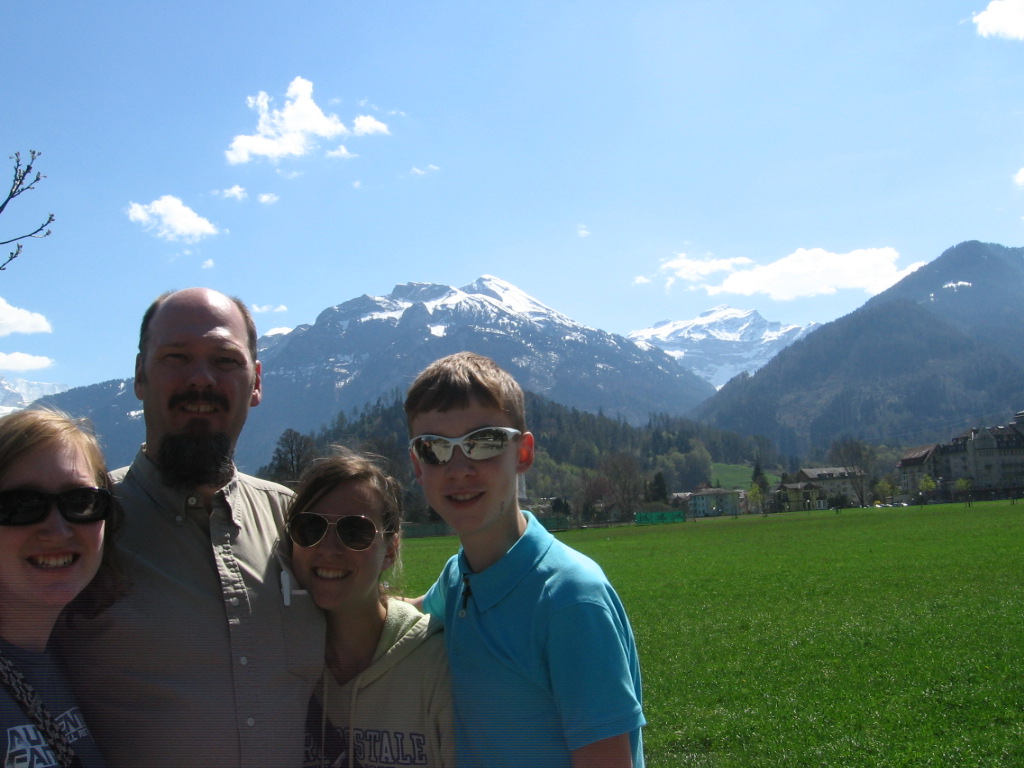
At Interlaken, Switzerland.  Beautiful town.  Reminds us of Banff, Alberta...just more green.

At Interlaken, Switzerland. Beautiful town. Reminds us of Banff, Alberta…just more green.

Wednesday PM – We arrived early to the airport in Zurich. We are glad we did! Our luggage was a problem with SwissAir. SwissAir only allows 1 piece of luggage per passenger. Carry-ons were no problem. We had to pay for the rest of our bags and send them on cargo airline. SwissAir wanted an outrageous amount, and being missionaries made no difference. It wasn’t cheap with the cargo plane either, but much cheaper than SwissAir. Michelle and I were so concerned and not sure what to do. God is teaching me (Mark) about the necessity of having joy in difficult situations. That was a test I failed in this situation. I did remain calm, but was not happy. The good news is, our luggage is to arrive in Entebbe this coming Tuesday (April 30th).

Thursday (25th) – We flew on SwissAir all night Wednesday night (leaving at 10:45 PM) and landing in Johannesburg, South Africa at about 9:45 am Thursday morning local time. I barely slept at all, but the meals were great. Time zone is the same as Zurich (6 hours ahead of EDT and 9 hours ahead of PDT). Our flight left South Africa for Entebbe at about 2:00 pm local time on Thursday and arrived Entebbe at 7:00 pm Thursday night.

The airport in Entebbe has been upgraded and is nicer than we (Michelle and I) remembered. The visas were no problem. Joshua immediately felt the “heaviness” of the air in Entebbe. It can be humid. The smells of Uganda that night, as we drove to our hotel in Entebbe, reminded me of our earlier short-term trip a few years ago. The sun sets at 7:00 pm each night (since Uganda is on the equator), so it was dark by the time we were in the small SUV’s which transported us to the hotel.

The Boones did a great job reserving this hotel for us – clean, professional staff for Uganda standards.

Friday (26th) – We woke up early (about 3 am) to a thunderstorm. Alexis was the only one to sleep through it. We had a small breakfast at the hotel and departed for Jinja at 10:00 am local time. The ride through Kampala (the capital of Uganda) was plagued by traffic. The heat was tolerable, but we drove with our windows down. Air conditioning is a luxury in Uganda.

On Saturday night, as our family reviewed our Friday trip, I asked during our family quiet time, “What surprised you the most about Uganda?” Joshua answered, “the traffic.” He said it seemed at times that a 2-lane road became a 4-lane road – with motorbikes, bicycles and pedestrians mixed in the confusing jumble. He was right. Ugandans drive on the left side of the road, too. The drive was anxiety producing at times, although the driver was very experienced.

On Friday, we arrived in Jinja at about 1:30 PM local time. Our Equip team met us at the Guesthouse where we will be staying until Tuesday (30th) – Jeremy and Tamara Boone, Luke Anderson, Anna and Patrick Draku, and Chris and Jane Sperling. Anna and Patrick, we had not met.  We will be staying in the Sperling’s house beginning some time in June for one year while they are on furlough in Abbottsford, BC, Canada.

The Boones provided rolexes (the breakfast burrito of Uganda) – an egg wrapped in Chipati bread (thicker version of a tortilla). See this link for info and how to make these delicious wraps: http://www.gwu.edu/~geog/ammap/pdfs/uganda-chapatirolex.pdf

Friday evening (26th) – the Boones invited us over for Dinner. Tamara made homemade pizza. That was even better than the rolexes. Then we turned in for the night around 11:00 pm.

Saturday (27th) – was a day for settling in. We slept late. Had breakfast at the Guesthouse (we have no kitchen and they provide one affordable meal per day). And then Jeremy took us to town to help with getting Internet and cell phone, so we could communicate here and back home.

Sunday (28th) – Church service with Acacia Community Church. Our Equip team members all attend this church, as well as the Via family from Raleigh, NC (thanks for the heads up Chelsea Poteat).  The afternoon was spent chatting with family on FaceBook and preparing this blog.

All in all, this week has been a whirlwind of a trip, but we’re happy we’re here. Joshua said earlier this week, “This feels like home, just different.” The message Sunday morning was excellent, and needed. The church is going through the 2 epistle of Peter. Today they were in chapter 1. Pastor Terry covered 2 of the 7 steps to spiritual maturity, self control and perseverance. Sobering message, and very timely for us.

I’ve often wondered about how the children will cope with this experience, although each of them have received their own individual call to Uganda. As we were sharing last night in our family quiet time, Brittany shared that she thought God had impressed upon her as we were driving to Jinja Friday that Uganda is her home now, and God is at work. She believes God wants her to keep her eyes open to where God is working so she can join Him.

The kids at the front entrance to the Guesthouse, Sunday afternoon.

The kids at the front entrance to the Guesthouse, Sunday afternoon.

Michelle and I have watched our kids, as well as ourselves through this process. It has been absolutely amazing to see how Jesus has prepared us for such a time (and place) as this. This is not to say we are any better or any more special than anyone else, but God is special. Each of us struggle day to day. We have our weaknesses. We fail miserably, but God is faithful! The situations (both good and bad) He is using in our lives (yours and mine, as we trust Him), are for His glory and ultimately for our good. The situations are not good, but the results of those situations God will work for good. That, He has promised us! Thanks so much for your support and prayers! Jesus first!!!

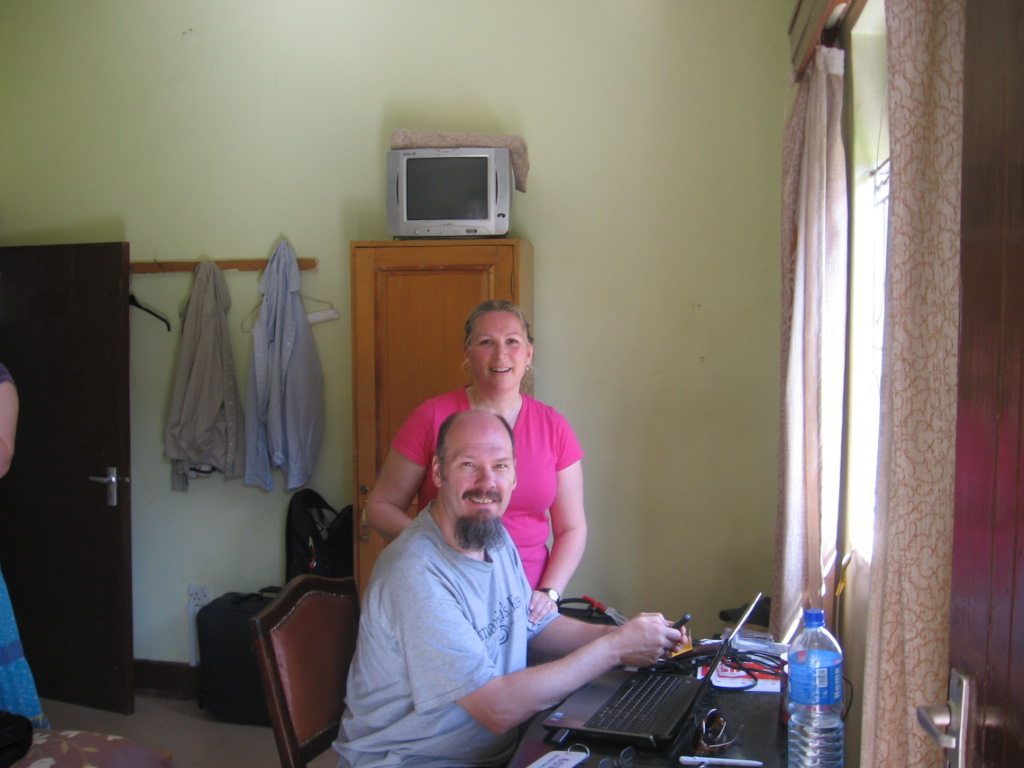
Here we are in our room in the Bridgeway Guest House. The children are in a room beside us. We are here until Tuesday morning. This is where we stayed when we were here before.

Here we are in our room in the Bridgeway Guest House. The children are in a room beside us. We are here until Tuesday morning. This is where we stayed when we were here before.